このたびBambinart Galleryでは、堀聖史 個展「あくびのそと」を開催いたします。
電車の窓に映る人々や、瞬く間に流れ去る風景。そこでは、さまざまなイメージが重なり合いながら現れては消え、目に映ったものを記憶にとどめようとする間にも、次の光景へと移り変わっていきます。堀聖史は、こうした日常の視覚体験を通して、私たちが世界をどのように見ているのか、そして目の前にあるものをどこまで捉えることができるのかを問い続けてきました。
堀聖史 本展ステイトメント
(電車にて)
ふと目に飛び込んでくるあくびが、全てを飲み込むような強烈な印象を与える。
この場所はその公共性ゆえに、むやみに写真に収めることができない。そのため多くの人の記憶において、ここでの体験は曖昧なものとなっていく。さらに窓の外に見える全てのものは、今この瞬間も瞬く間に飛び去っていく。イメージを掴もうとするその僅かな間にも、神聖幾何学のような看板や、あらゆる存在の紋章やサイン、伸ばし棒や句読点のような光線が背後に消えていく。私が小さな頭で考え出したテーマやモチーフは、そうした克明で俊敏なイメージの隙間や周囲を、幽霊のように居場所なく漂っているに過ぎない。
すべては過去でも未来でもなく、今、私の目の前にある。線路に対して垂直に開かれた窓のような「今」という瞬間において、私にできるのは目撃するために目を開き続けることだけだ。
駅に着くたびに人々は席を立ち、また新しい人が乗ってくる。その服や仕草、肌の構成はその度にそっくり入れ替わり、頭と頭の間に覗く景色や反射の正確な奥行き・形さえ捉えることはできない。そうして、あくびが伝染するように日常の中心に開口部が開かれていく。それは森の入口のように私を招き入れるが、無闇に立ち入ってはならない。私はそのあくびをただ眺めていればいいのだ。私はこれからその中へ入っていくのではなく、その中から来たのだ。
この公共性と過剰な情報量は、イメージを完全に我が物とすることから私を引き留めてくれる。それでもここに絵があるのは、その開口部の中身を知ることを放棄する代わりに、その外観の素晴らしい構成や色彩を、取り分けてもらったのだ。
(堀聖史)
これまで堀の個展ステイトメントでは、消えていく風景と記憶の喪失(「ランタイムのともだち」/2019)、見る主体と見られる世界の衝突(「まなざし仮面」/2020)、見えるものの向こう側への想像(「ヘアリー・フェアリー」/2021)、目に映るものの実体や時間への疑念(「過去虹」/2022)、知覚そのものへの疑い(「甘い目」/2023)、そして目には見えないもの同士の結びつきと時間への思索(「マジックタイム・スイートホーム」/2024)が、さまざまな言葉で語られてきました。そこに一貫しているのは、世界を自分の認識によって確定させることへのためらいと、知覚の及ばない領域に対する想像力です。
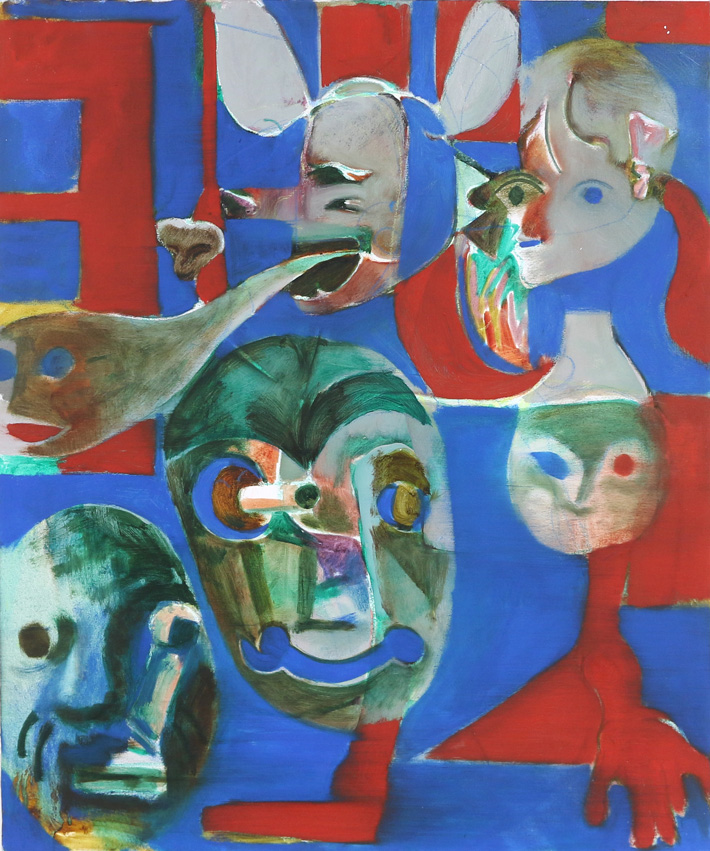
今回の作品において、人物の顔や動物を思わせる形態、記号的な図形は、鮮烈な色彩とともに画面のなかで重なり合い、互いの輪郭を侵食しながら共存しています。そこでは、個々のイメージを特定し、意味を読み解くことだけでは捉えきれない、形態や色彩の関係そのものが前景化します。
世界を見ようとすることと、世界を捉えきれないことのあいだで、絵画はいかにして生まれるのか。本展は、堀聖史のこれまでの探究を引き継ぎながら、見ることと描くことの関係をあらためて問いかけます。
どうぞご高覧ください。
People reflected in train windows, landscapes rushing past in an instant. Images overlap, emerge, and disappear, shifting into the next scene even as we try to retain what we have just seen in our memory. Through these everyday visual experiences, Hori has continued to explore how we see the world and how much of what lies before our eyes we are actually able to grasp.
Satoshi Hori
— Artist’s Statement for the Exhibition
*(On the Train)*
A yawn that suddenly catches my eye makes an overwhelming impression, as though it were swallowing everything around it.
Because this is a public space, I cannot simply photograph whatever I see. As a result, for many people, their experiences here gradually become indistinct in memory. Moreover, everything visible beyond the window is rushing away in an instant, even as I write. In the brief moment I spend trying to grasp an image, signs resembling sacred geometry, emblems and signs of all kinds of existence, and rays of light like Japanese long-vowel marks and punctuation marks disappear into the background. The themes and motifs I have devised with my small head merely drift like ghosts, without a place to settle, in the gaps between and around these vivid, swift-moving images.
Everything exists neither in the past nor in the future, but here, now, before my eyes. In this moment called “the present,” like a window opening perpendicular to the railway tracks, all I can do is keep my eyes open in order to bear witness.
Each time the train arrives at a station, people rise from their seats and new passengers board. Their clothes, gestures, and the very composition of their skin are replaced almost entirely each time. I cannot even grasp the precise depth or form of the scenery and reflections glimpsed between their heads. And so, as if a yawn were contagious, an opening emerges at the very heart of everyday life. It invites me in, like the entrance to a forest, but it is not somewhere I should enter indiscriminately. All I need to do is gaze at that yawn. I am not about to enter into it; I came from within it.
The public nature of this space and its overwhelming abundance of information hold me back from making these images entirely my own. And yet, paintings exist here because, in exchange for relinquishing the attempt to know what lies inside that opening, I have been allowed to take away something of the remarkable compositions and colors of its exterior.
(Satoshi Hori)
In his previous exhibition statements, Hori has explored a range of themes: disappearing landscapes and the loss of memory (*Runtime Friends*, 2019); the collision between the observing subject and the world being observed (*Masked Gazer*, 2020); imagining what lies beyond the visible (*Hairy Fairy*, 2021); doubts about the substance and temporality of what appears before our eyes (*Past Rainbow*, 2022); questioning perception itself (*Sweet Eyes*, 2023); and reflections on the connections between unseen things and the nature of time (*Magic Time, Sweet Home*, 2024). Running consistently through these explorations is a reluctance to define the world through the limits of one’s own perception, alongside an imagination directed toward realms beyond its reach.
In the works presented in this exhibition, forms suggestive of human faces and animals, together with symbolic and geometric shapes, overlap across the picture surface in vivid colors, coexisting as they encroach upon one another’s contours. Rather than inviting us simply to identify individual images and decipher their meanings, the paintings bring to the fore the relationships between forms and colors themselves—relationships that cannot be fully grasped through such acts of interpretation.
Between the desire to see the world and the impossibility of fully apprehending it, how does painting come into being? Building upon Hori’s ongoing investigations, this exhibition once again poses questions about the relationship between seeing and painting.
We look forward to welcoming you to the exhibition.